


India is moving quickly to meet its goals for energy through the National Solar Mission and the PM Surya Ghar Yojana. The need for PV modules that are dependable, trustworthy, and long-lasting has never been greater. Manufacturers, EPC contractors, and project developers all ask the question before putting panels into use: will this solar PV module work safely and well for twenty-five years or more in real conditions? Solar PV modules must perform reliably over time.
That is what IEC 61215 is designed to address. Presto Laboratories is a testing lab in India that is approved by BIS and has ISO certification. This lab helps with solar PV module testing. This lab helps solar PV module manufacturers get into the market. This lab helps solar PV module manufacturers gain trust from customers. The testing done by this lab is recognized around the world. If you are looking for a Solar PV Module testing laboratory in India or IEC 61215 PV module testing, email us at info@prestolaboratories.com.
IEC 61215 is the standard that people around the world trust when they need panels to be designed and approved. IEC 61215 was created by the International Electrotechnical Commission, the group that sets these standards. IEC 61215 sets the rules for the design qualification of photovoltaic modules that are meant to work for a time in regular outdoor weather conditions, as explained in IEC 61836. Presto can help with photovoltaic module testing because they are a trusted BIS-approved and ISO-recognized laboratory in Faridabad.
The standard is split into two complementary parts:
The IEC 61215-1 standard tells us how to test flat-plate photovoltaic modules and judge how well they work and how reliable they are. The IEC 61215-1 standard gives the stress conditions that a module must survive. The IEC 61215-1 standard also lists what is acceptable, such as the amount of power loss that is allowed, the lowest insulation resistance that's acceptable, and the kinds of problems that are considered tolerable.
The standard IEC 61215-2 explains the testing procedures, the steps that must be taken, and the methods for doing each qualification test. The standard IEC 61215-2 sets the conditions for deciding how to use the settings for the environmental chamber and the rules for figuring out whether a test is a pass or a fail. The standard IEC 61215-2 makes sure that the test results stay the same and can be compared in any laboratory that is approved around the world.
Together, the two parts are the main part of testing for solar panels that is used by companies that make the panels, organizations that check the quality, people who give money for projects, and companies that build big solar power plants all over the world.
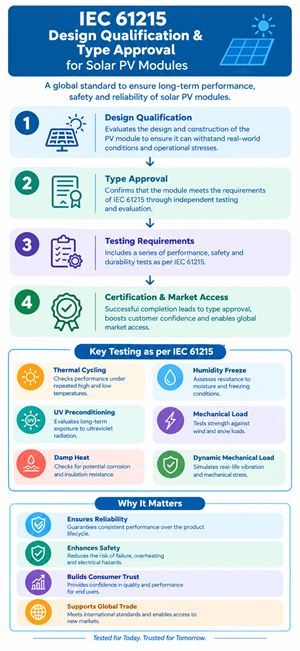
Financial institutions and project investors often need IEC 61215 certification before they will approve loans or provide insurance for assets. A module that has passed IEC 61215 testing is called bankable. This bankable status lowers the perceived risk of the project.
In countries like India, the ALMM framework is used, and BIS rules are followed. They require IEC 61215 type approval before a module can be listed, imported, or deployed in projects funded by the government. IEC 61215 type approval is mandatory for any module that's to be used in such projects.
Modules face cold changes, moist air, sunlight, wind, snow, and electrical stress for many years. Design qualification works like a test that mimics many years of this harsh environment in a short lab period, and it finds problems in the design or the material before we roll them out to many people.
Manufacturers that put effort into module testing are less likely to face problems in the field. They also reduce warranty claims. Avoid damage to their reputation. This makes a difference when competing in the solar manufacturing industry.
IEC 61215 is widely recognized in export markets. That recognition of IEC 61215 helps Indian manufacturers compete globally. Indian manufacturers can rely on test data from laboratories. IEC 61215 gives them confidence when entering markets.
IEC 61215-2 lays out the qualification steps in Module Quality Test (MQT) sequences. IEC 61215-2 splits modules into sample groups. Runs a set of specific tests on each group. Below you will find a look at the main test modules:
At the end of every sequence, modules go through another round of MQT 01, which is a visual inspection; MQT 02, which checks power output; and MQT 03, which checks insulation. These tests confirm that performance degradation and safety parameters stay within the acceptance criteria set by IEC 61215-1. To pass, modules must show power degradation within the limits. Must not have any major visual or safety defects.
Presto Laboratories is a service-based testing organization, and our approach to IEC 61215 testing is structured for accuracy, transparency, and speed:
Presto Laboratories is a BIS-approved and ISO-certified PV testing laboratory that is designed to help manufacturers, EPC contractors, and project developers with test data that follows the standards.
If you are a module manufacturer getting ready for ALMM listing, if you are an EPC contractor checking supplier quality, or if you are an investor doing due diligence, Presto Laboratories offers the technical precision and reliability that your solar projects need. Presto Laboratories supports every stage of your projects.
The IEC 61215 Design Qualification and Type Approval is a requirement for any panel that wants to be sold in the Indian market or in any global market. This process checks power output and insulation. It also runs stress tests that imitate real-world conditions such as temperature changes, high humidity, and hail damage. By doing this set of tests, the IEC 61215 process makes sure that a solar panel can perform well for many years in actual environments.
For companies that make panels for those who build solar projects and for people who invest in solar energy, working with a testing company that is officially recognized and approved by BIS and certified by ISO, like Presto Laboratories, means they can reach the market, gain more trust from banks, and feel more confident about how well the panels will work over time. It is easy to see the advantages. As the amount of power in India grows, testing based on strict standards will stay important to create a reliable and trustworthy energy system.
Ensure your solar PV modules meet the highest performance, the safest operation, and the strongest durability with IEC 61215 Design Qualification and Type Approval from Presto Laboratories. Presto Laboratories is a BIS-approved and ISO-certified testing laboratory in India. Make sure your solar PV modules meet the standards of performance, the safest operation, and the strongest durability with IEC 61215 PV Module Testing from Presto Laboratories.
Call us: +91-8882991991.
Email us at: info@prestolaboratories.com
Team up with Presto Laboratories for standards-compliant solar panel testing services because reliable solar energy depends on modules that are rigorously tested by Presto Laboratories, and reliable solar energy will keep your lights on.
Yes. Modules that appear under ALMM and in government tenders must have IEC 61215 type approval.
IEC 61215 is about design qualification and how reliably a product performs over time. IEC 61730 deals with safety and fire safety testing. Both standards are usually needed together to get module certification.
Yes, our team supports partial retesting protocols. The team follows IEC 61215-2 requirements for retesting protocols. The team also applies retesting protocols when manufacturers modify materials, components, or design elements.
Yes. Presto Laboratories operates as a BIS-approved and ISO-certified testing organization. This means our processes and reports meet recognized international quality benchmarks. We follow standards to ensure reliability and accuracy in everything we do.




 Talk to Us
 Book a Test
 Drop a Query